Table of Contents
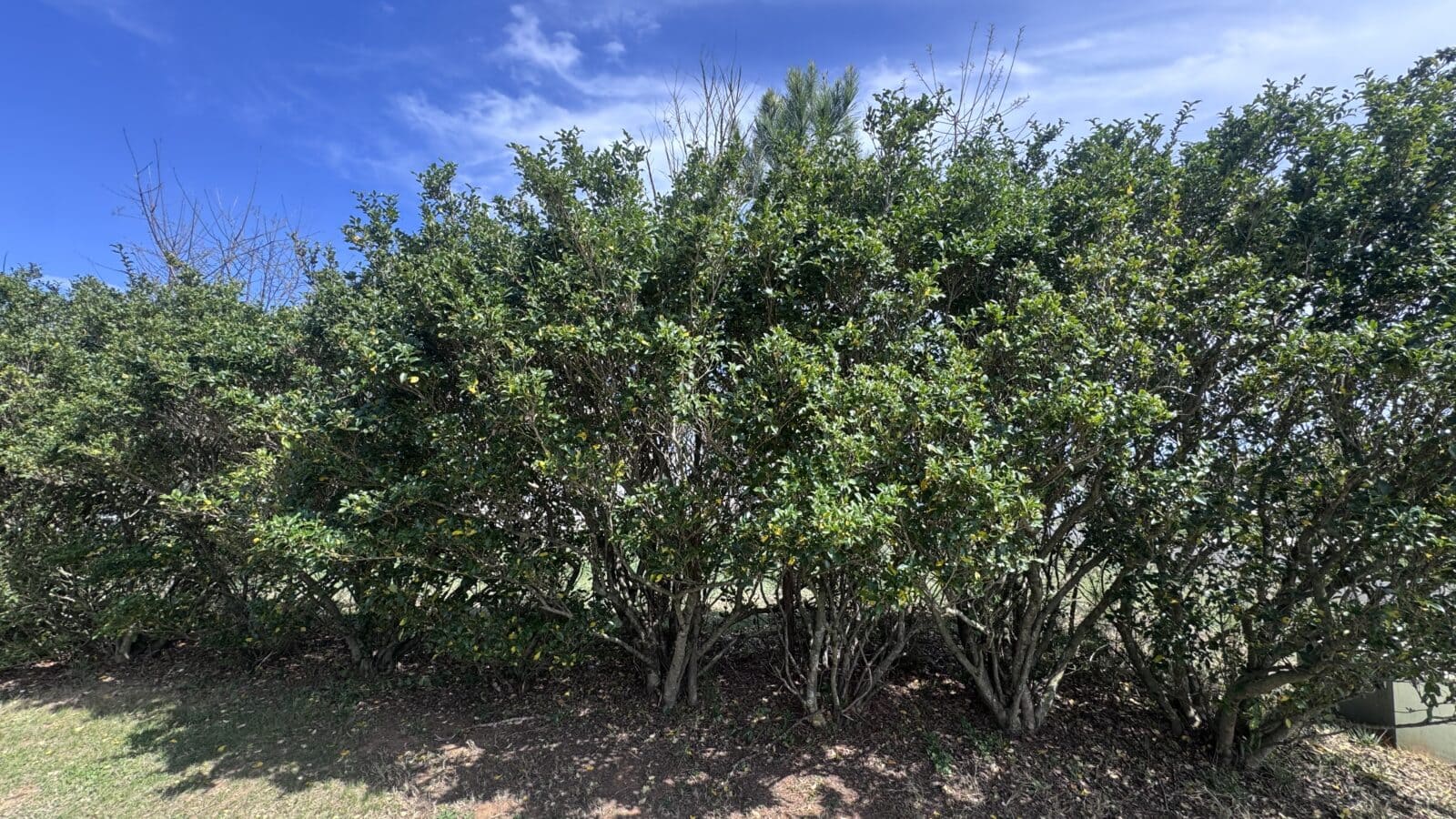
Is That Overgrown Shrub Taking Over Your Property?
If you have a dense, fast-growing evergreen shrub swallowing your fence line, driveway border, or property edge — and it seems to double in size every time you look at it — there’s a very good chance you’re dealing with **Japanese Privet** (*Ligustrum japonicum*). Across the greater Charlotte, NC region, this is one of the most frequently encountered overgrown shrubs we see on residential properties, and for good reason: left unmanaged, it is relentless.
At Morrow Ridge Landscaping, proper **Japanese Privet trimming and shrub renovation** is something our team handles with precision every season. In this guide, we’ll walk you through exactly how to identify your shrub, assess its condition, plan your pruning approach, and clean up the site afterward — the right way, the first time.
Step 1: Identify Your Shrub Before You Cut Anything
Never pick up a pruner before you know what you’re pruning. Timing, technique, and strategy all hinge on a correct identification — and Japanese Privet is frequently mistaken for several other common Southern shrubs, including Camellia and Osmanthus.
How to Identify Japanese Privet (Ligustrum japonicum)
Japanese Privet is one of the most common broadleaf evergreen shrubs in the Piedmont Carolinas. Here’s what to look for in the field:
- Leaves: Dark, glossy green on top with a noticeably paler underside. Leaves are oval to broadly elliptical, roughly 2–4 inches long, with **smooth (non-serrated) margins** and a thick, leathery, almost waxy texture. The leaf tips come to a soft point.
- Stems & Bark: Young stems are green, maturing to a smooth gray-brown. The plant is naturally multi-stemmed, emerging from a dense cluster of trunks at ground level.
- Flowers: Small, creamy-white flower clusters (panicles) appear in **late spring to early summer** — typically May through June in the Charlotte area. The blooms carry a sweet, sometimes heavy fragrance that can be detected from a distance.
- Berries: Following bloom, dark blue-black berry clusters (drupes) develop and persist into winter. These are toxic to humans and pets but are consumed and spread by birds — a key reason this plant naturalizes so readily.
- Size: Unmanaged specimens in the Carolinas routinely reach 10–15 feet tall with an equal or greater spread, often forming impenetrable thickets along property lines and woodland edges.
A Note on Invasiveness: Japanese Privet is listed as an **invasive exotic species in North Carolina**. While it remains widely present on established residential properties throughout the Charlotte region, it is important for homeowners to understand that its berries spread readily into natural areas via wildlife. Managing it responsibly — including proper disposal of pruned material and berries — is part of being a good steward of the local landscape. For a full botanical profile including cultivar information and invasive status, the NC State Extension Gardener Plant Toolbox is the definitive resource.
Step 2: Assess the Condition and Understand What You’re Working With
Before developing a pruning plan, walk the shrub carefully and take stock of what you’re dealing with.
Structural Assessment
- Main trunk count:
- How many primary stems emerge from the base? Japanese Privet is aggressively multi-stemmed and can develop dozens of main canes on a mature, neglected specimen.
- Crossing or rubbing branches:
- These create wounds that invite fungal pathogens and should be priority removals.
- Dead wood:
- Look deep into the interior canopy for gray, brittle, bark-sloughing stems. Dense outer growth on mature Privet often shades out the interior entirely, leading to significant internal dieback.
- Canopy density:
- Is the interior hollow and lightless? This is extremely common on neglected Ligustrum and creates ideal conditions for scale insects and fungal issues.
- Ground clearance:
- Are the lowest branches in contact with the soil? This is a direct pathway for root rot and crown fungal disease — a meaningful risk given the heavy clay soils and humid summers characteristic of the Carolina Piedmont.
- Berry load:
- Note whether the shrub is carrying significant berry clusters. These should be removed and bagged — not composted — to prevent further spread.
Understanding the Severity
Overgrown Japanese Privet typically falls into one of two categories:
- Maintenance-neglected:
- Overgrown but structurally sound. Responds well to a phased thinning, reduction, and limbing-up approach over one to two growing seasons.
- Full renovation candidates:
- Extremely dense, hollow in the center, with heavy dead wood accumulation and potential root competition issues. These may benefit from a hard rejuvenation pruning strategy — or in some cases, full removal and replanting with a better-suited, non-invasive alternative species.
Step 3: Know the Right Time to Prune Japanese Privet in North Carolina
Timing is one of the most important variables in any pruning project — and Japanese Privet is actually one of the more forgiving shrubs in this regard.
- Best time for major renovation pruning:
- Late winter to very early spring — February through early March in the Charlotte area, just before the plant breaks dormancy and pushes new growth. This allows the plant to heal pruning wounds and push vigorous new growth quickly as temperatures rise.
- Best time for maintenance shaping:
- Immediately after the bloom cycle concludes — typically late June to early July in the Piedmont. This preserves the flower display while keeping size in check.
- Avoid pruning in late summer or fall:
- While Ligustrum can tolerate almost any pruning timing, cutting late in the season stimulates tender new growth that may be damaged by early frosts — more relevant in the western foothills of NC but still a consideration in the Charlotte metro area.
The key advantage of Japanese Privet over more sensitive ornamentals: it is extraordinarily resilient and can tolerate very aggressive pruning, including being cut nearly to the ground in a hard rejuvenation scenario. It will come back. The question is always whether you want it to. For a deeper dive on pruning timing by shrub type, Clemson’s Home & Garden Information Center offers an excellent reference guide.
Step 4: Gather the Right Tools
Using sharp, properly maintained tools isn’t just about efficiency — it’s about plant health and professional results. Torn, crushed cuts from dull blades are an open invitation for the fungal issues that thrive in our hot, humid Carolina summers.
Essential Tools for Japanese Privet Pruning:
- Bypass hand pruners (not anvil-style):
- For stems up to ¾ inch in diameter. Bypass blades make clean, precise cuts that heal properly and don’t crush the stem tissue.
- Loppers:
- For stems from ¾ inch to 2 inches. A quality ratcheting lopper is invaluable when working through the dense interior of a mature Privet.
- Pruning saw:
- For main trunks and stems over 2 inches in diameter. A folding Japanese-pull saw offers excellent control in tight, congested spaces.
- Pole pruner or pole saw:
- For reaching upper canopy without a ladder where possible.
- Isopropyl alcohol or diluted bleach solution (10:1 water to bleach):
- To sanitize blades between cuts, particularly important when cutting out diseased or dead wood.
- Heavy leather gloves and eye protection:
- The interior of a densely overgrown Privet is a tangle of sharp, whipping stems. This is non-negotiable.
- Tarps or a wheelbarrow: Japanese Privet generates an enormous volume of cut material. Have a plan for moving it before you start.
Step 5: Execute the Pruning — The Professional Sequence
Approach this work methodically. Experienced landscape professionals follow a disciplined sequence for a reason — it prevents costly mistakes and produces a result that looks intentional, not hacked. For a thorough breakdown of cut types and technique, NC State Extension’s pruning technique guidance is an excellent reference — and notably uses privet as a demonstration plant in its figures.
Phase 1: Remove All Dead Wood First
Begin deep inside the canopy. Remove all dead, dying, and crossing branches, cutting back to a healthy lateral branch or to the branch collar — the slightly raised ring of tissue where a branch meets the trunk. Never leave stubs. They die back, rot inward, and become a persistent disease vector in the plant.
Phase 2: Limb Up the Base
One of the most transformative things you can do with an overgrown Japanese Privet is remove the lowest branches to expose the multi-trunk base structure. This does several important things:
- Eliminates soil contact and reduces disease risk
- Dramatically improves airflow through the lower canopy
- Transforms a dense, shrubby thicket into an elegant, tree-form specimen with visible trunk structure — a sophisticated look that photographs beautifully and adds genuine landscape value
Aim to clear the bottom 18–24 inches of trunk, or more if the structure supports it. Use your pruning saw for the larger lower limbs and make clean cuts flush with the collar.
Phase 3: Thin for Airflow and Interior Light
The goal is to open the canopy so light penetrates to the interior and air moves freely through the plant. For an overgrown Privet, this typically means:
- Removing 25–35% of total branch mass in a single season
- Eliminating any branch growing inward toward the center of the plant
- Selectively removing entire lateral branches rather than “heading back” every stem — heading back creates a dense, twiggy outer shell with a hollow, dead interior, which is precisely the problem you’re trying to solve
Think in terms of revealing the plant’s natural architecture, not just reducing its mass.
Phase 4: Height and Width Reduction
With the interior cleaned out, address overall size. Always cut back to a healthy outward-facing lateral branch — never cut a stem mid-length without a lateral to redirect growth from. Make cuts at a slight angle just above the lateral to shed water and discourage rot.
For dramatic reductions, do not remove more than one-third of the plant’s total mass in a single growing season — unless you are executing a deliberate full rejuvenation cut (see below). Over-pruning stresses the plant and triggers weak, disorganized regrowth.
Hard Rejuvenation: When to Cut It to the Ground
If the shrub is so severely overgrown that thinning and reduction won’t produce a satisfactory result — or if you want to restart with a clean, manageable framework — Japanese Privet can be cut back to 6–12 inches from the ground in late winter. It will re-sprout vigorously. This is a dramatic step, and the plant will look bare for a full growing season, but it is the most effective way to reclaim a completely out-of-control specimen and establish a new, manageable structure.
Step 6: Post-Pruning Care — Set the Plant Up for Recovery
Pruning is a controlled stressor. What you do immediately afterward determines how quickly and vigorously the plant recovers.
Mulching
Apply a 2–3 inch layer of high-quality shredded hardwood mulch in a ring around the base, keeping it pulled back 2–3 inches from the main stems. Mulch piled against the trunk traps moisture and promotes the crown rot and fungal issues that are already a consideration in our heavy Carolina clay soils. Proper mulching moderates soil temperature, conserves moisture during summer drought, and suppresses weed competition during the recovery period.
Fertilization
Hold off on fertilizer for 4–6 weeks following a significant pruning. Allow the plant to focus energy on healing wounds before stimulating new growth. When you do fertilize, a balanced slow-release granular fertilizer is appropriate for Japanese Privet — unlike acid-loving camellias or azaleas, Ligustrum is adaptable to a wide soil pH range and doesn’t require a specialized formulation.
Monitor for Pests
Japanese Privet is susceptible to several specific insect pests, including white peach scale and the ligustrum weevil — a pest first documented in North Carolina that shows a particular preference for *L. japonicum*. The stress of a heavy pruning can make plants temporarily more vulnerable to infestation. Monitor closely in the weeks following pruning and treat with horticultural oil if scale populations are detected. For a complete overview of pests specific to this shrub, refer to NC State Extension’s guide to Ligustrum pests.
Watering
If pruning is followed by a dry period — not uncommon in the Charlotte area from late spring onward — deep, infrequent watering (approximately 1 inch per week) will support recovery and reduce the stress response on a heavily pruned plant.
Step 7: Site Cleanup — Leave It Better Than You Found It
Professional-grade work doesn’t end when the last branch falls. Thorough, disciplined cleanup is a hallmark of quality — and with Japanese Privet, it carries an extra layer of environmental responsibility.
Cleanup Protocol:
- Rake and remove all cut material from within the drip line of the shrub immediately. Do not leave piles of cut stems and foliage to decompose in place.
- Bag and dispose of all berry clusters — do not compost them. Ligustrum berries remain viable and can sprout from a compost pile or mulch application, continuing the spread of this invasive species.
- Do not compost any Privet material if berries are present. Chip or haul away all woody debris.
- Refresh the mulch layer as described above.
- Clean and sanitize all tools before storing. This is not optional — it protects your other landscape plants and prevents pathogen transfer between pruning sessions.
Should You Keep It or Replace Your Japanese Privet?
This is a question worth asking honestly. Japanese Privet is a tough, reliable evergreen that provides year-round screening, tolerates a wide range of soil conditions, and produces attractive fragrant blooms. For properties where a dense, fast-growing screen is the priority, a well-managed Privet can serve a legitimate purpose.
However, given its invasive status in North Carolina, some homeowners choose to remove overgrown Privet entirely and replace it with high-performing, non-invasive alternatives that offer similar screening value. At Morrow Ridge Landscaping, our design team can help you evaluate whether renovation or replacement makes the most sense for your specific property — and if replacement is the right call, we’ll help you select premium native and adaptive alternatives. For an excellent locally-grounded starting point, NC Cooperative Extension has put together a list of the top 10 privet replacement plants specifically vetted for our region. Some of our favorites from that list and beyond include:
- Ilex x ‘Nellie R. Stevens’ Holly — dense, fast-growing, exceptionally clean evergreen screen
- Illicium floridanum (Florida Anise) — fragrant, shade-tolerant native with excellent screening density
- Viburnum obovatum ‘Walter’s Viburnum — a tough, compact native that provides year-round structure
- Osmanthus fragrans (Tea Olive) — evergreen with intensely sweet fall fragrance and refined appearance
When to Call a Professional to Prune or Trim Your Japanese Privet?
There is a meaningful difference between light maintenance pruning and a true shrub renovation project. If your Japanese Privet has reached the point where:
- It is threatening to contact your home’s siding, roofline, or HVAC equipment
- There is significant dead wood or disease deep within the canopy
- The shrubs occupy a high-visibility area where the work needs to look exceptional
- You’re unsure whether renovation or full removal and replanting is the right call
- The volume of material is beyond what you can safely and efficiently handle
…then you’re well past the scope of a weekend DIY project. The cost of a misstep — cutting primary trunks incorrectly, damaging roots, over-pruning into decline, or simply leaving the result looking unpolished — far exceeds the cost of bringing in the right team from the start.
Transform Your Landscape With Morrow Ridge Landscaping
At Morrow Ridge Landscaping, we approach every shrub pruning and renovation project the way we approach every aspect of our work: with the precision, expertise, and attention to detail that your property deserves. Whether you need a single overgrown Privet hedge renovated, a complete landscape bed transformation, or a comprehensive landscape management plan for your entire Charlotte-area property, our team is ready to deliver results that reflect the quality of your home.
Ready to reclaim your landscape?
Contact Morrow Ridge Landscaping today to schedule your consultation. We serve discerning homeowners throughout the greater Charlotte, NC region — and we’d be honored to make your outdoor space extraordinary
Call or text us to schedule your consultation. Visit our website to see our work and schedule a consultation.
Don’t let another growing season pass with an overgrown, unmanaged landscape. Let’s build something exceptional together.