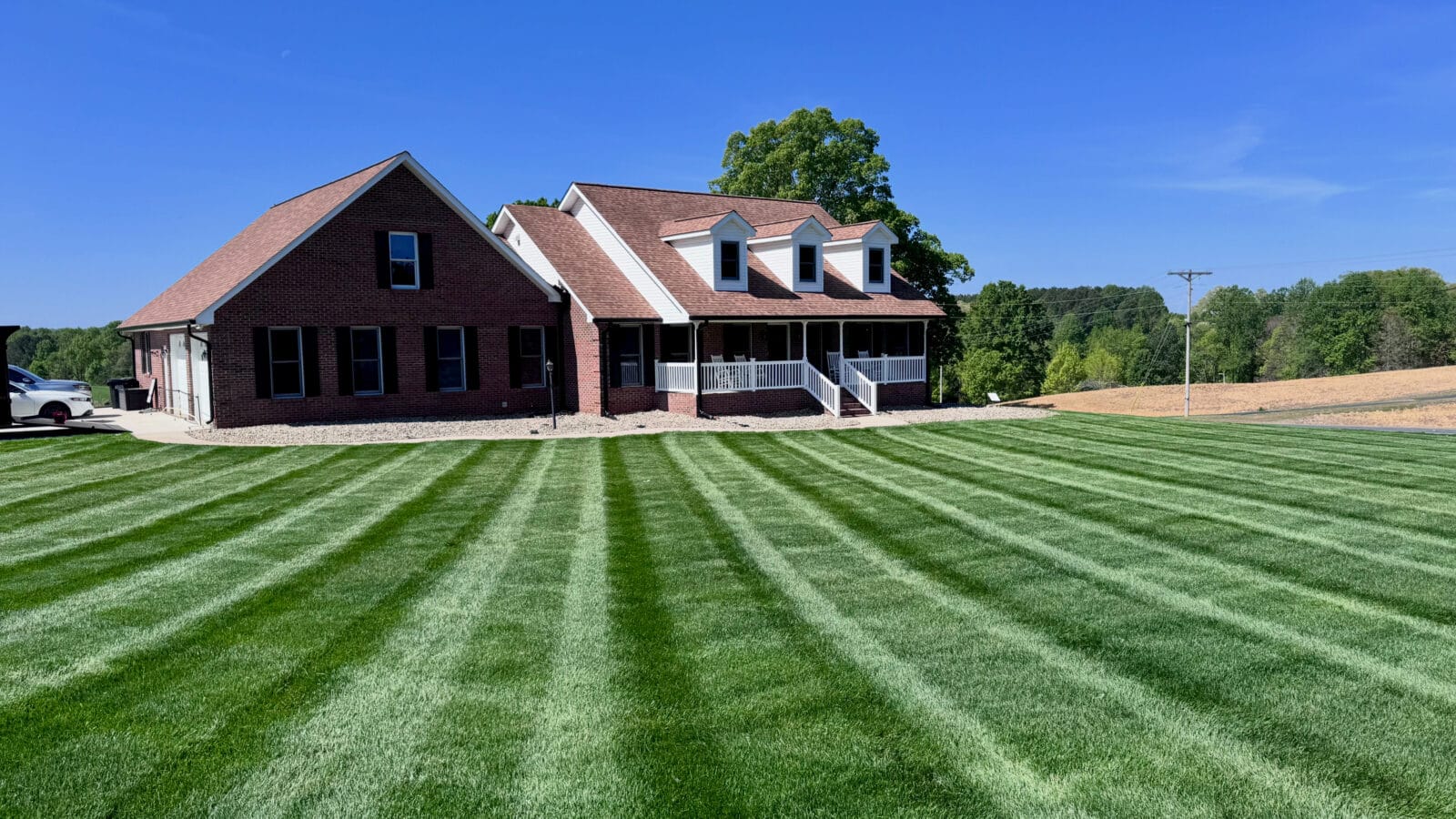
Drought is a recurring part of life in the NC Piedmont. When a dry stretch deepens, water restrictions and hard lawn decisions reach homeowners across Stanly, Cabarrus, Union, and Mecklenburg counties at about the same time. Planning for it is part of landscaping here.
This guide is what we tell customers on the phone when the conditions turn. What to water. What to let go. How to adjust your lawn care during drought in the Charlotte NC area, and how to protect your trees and beds until real rain returns. All of it is grounded in NC State Extension guidance and the U.S. Drought Monitor data for North Carolina. The principles hold whether you are reading this during an active D3 drought or a short dry stretch. If you want the short version at the end of your scroll, skip to Drought Lawn Care Checklist. Otherwise, work through it in order, because the decisions build on each other. For the maintenance side (mowing, edging, bed work), our lawn care and maintenance approach changes during drought, and we’ll show you why.
Table of Contents
Why NC Is Seeing More Droughts and What That Means for Your Landscape
The Piedmont swings between dry stretches and heavy rain, and our clay soils feel both ends of it. Soil that shrinks and hardens during a dry spell sheds water when a heavy storm finally arrives, so the same yard can face drought stress and runoff in the same year.
The science backs this up. NOAA’s State Climate Summary for North Carolina reports no overall trend in the state’s annual precipitation. It projects that naturally occurring droughts will be more intense and that higher temperatures will increase the rate of soil moisture loss during dry periods. It also projects heavier rainfall rates from hurricanes as the climate warms. The Fifth National Climate Assessment lists drought persistence and strength among the climate-related stressors facing the Southeast. The same assessment projects that extreme precipitation amounts across the Southeast will increase.
What that means for your yard. Landscapes designed for average conditions fail in actual conditions. A turf species, a drainage plan, a planting selection, or a mulching schedule that looks right on a spec sheet has to be built for both ends of the swing instead of the middle. The rest of this guide is built for that reality.
How to Check Current Drought Conditions and Watering Restrictions
Drought status and watering rules change as conditions change, and they can differ from one county or utility to the next. Check both before you make lawn, watering, or planting decisions.
Drought status. The NC Drought Management Advisory Council publishes the current U.S. Drought Monitor map for North Carolina with a classification for every county, from D0 (Abnormally Dry) to D4 (Exceptional Drought). Stanly, Cabarrus, Union, and Mecklenburg counties do not always share the same category, so look up your own county.
Watering restrictions. Your water utility sets restrictions under its Water Shortage Response Plan, and they usually move from voluntary to mandatory stages as a drought deepens. The NC Division of Water Resources keeps a statewide Water System Conservation Status table that lists each public water system as not restricted, voluntary, mandatory, emergency, or rationing. For the larger utilities in our service area, check these pages:
- Charlotte Water (Mecklenburg County): the Drought Resources page shows the current Low Inflow Protocol stage and the watering rules that go with it.
- Union County Water: the county posts its current restriction stage and irrigation schedule on the Union County website.
- City of Concord (Cabarrus County): the Water Use Guidelines page lists the current restriction level for customers in Concord. If you live in Harrisburg or another Cabarrus town, find your own water system in the state table.
- City of Albemarle (Stanly County): water service runs through the city’s Public Utilities department. For Albemarle and the smaller Stanly County systems, use the state table or call your utility if restrictions are not posted online.
Check your utility’s current rules before watering, and check again as conditions change, since voluntary stages can move to mandatory ones if a drought deepens. If you are on a private well you are not bound by municipal restrictions, but the same drought-aware practices apply, because your well is drawing from the same stressed groundwater.
What each drought level means for your yard. The impacts in quotes below come from the NC Drought Management Advisory Council. The yard decisions are how we apply the rest of this guide at each level.
- D0 Abnormally Dry (“Brown lawns, mild stress on crops, pastures”): keep new plantings on a regular watering schedule, refresh bed mulch, and raise the mower deck.
- D1 Moderate Drought (“voluntary conservation”): pick your lawn lane now, and move trees and shrubs planted in the last two years to the top of the watering list.
- D2 Severe Drought (“water-use restrictions may begin”): expect sprinkler limits. Switch priority plants to hand watering or drip, and hold off on fertilizer, herbicides, and new planting.
- D3 Extreme Drought (“more severe mandatory restrictions”): let most lawns go dormant with a crown-saving watering every three weeks, water only priority plants, and watch retaining walls and bed edges for shrinkage cracks.
- D4 Exceptional Drought (“critical water shortages affecting communities, agriculture, and daily life”): follow your utility’s rules to the letter and put any water you are allowed on the trees and shrubs that would cost the most to replace.
What Drought Does to Lawns, Trees, and Beds in the NC Piedmont
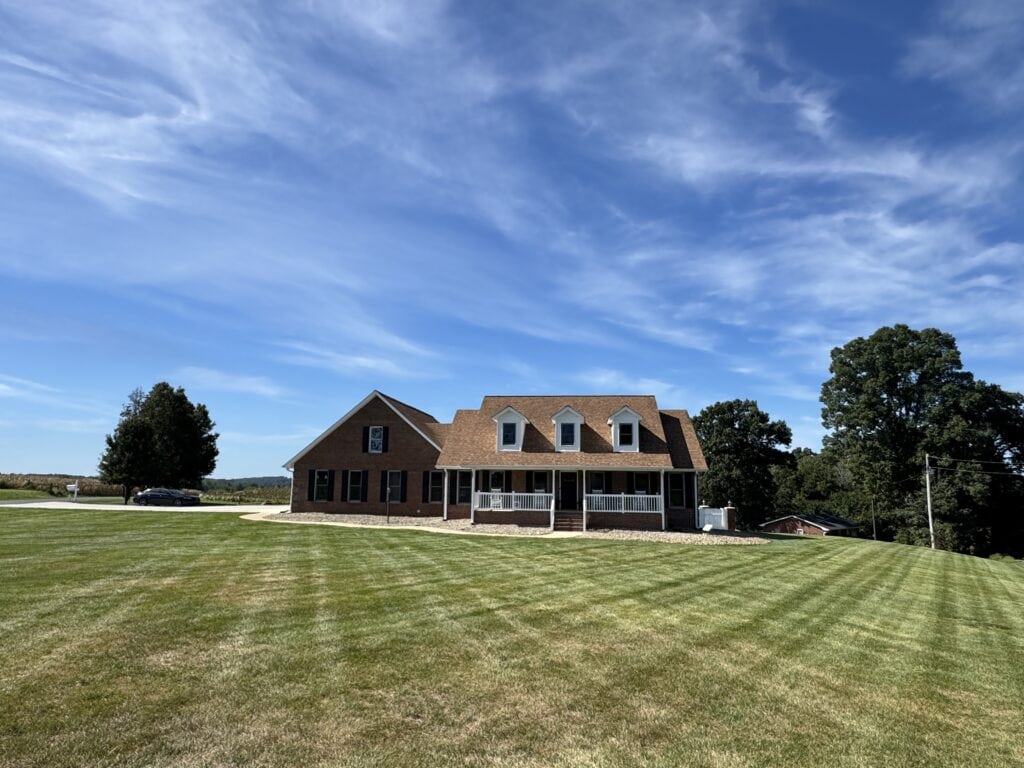
Our entire service area is USDA Zone 8a. That means most residential yards are some combination of tall fescue, bermudagrass, and zoysiagrass, with landscape beds of boxwood, hydrangea, azalea, Japanese maple, crepe myrtle, and various ornamental grasses. Each of these reacts differently as a drought deepens.
Tall fescue (cool-season). Fescue is our most common Piedmont lawn grass, and it is the most vulnerable of the three in a long drought. As drought deepens, fescue stops growing, turns straw-brown, and goes dormant to protect its crown. NC State Extension confirms this is its survival mechanism. A dormant fescue lawn has shut down and is still alive. Thin, weak stands may lose crown tissue entirely and will need to be reseeded in fall.
Bermudagrass and zoysiagrass (warm-season). Both handle drought far better than fescue. Their root systems run deeper. They slow their growth and conserve energy. Per NC State Extension, bermudagrass and zoysiagrass are both tolerant of drought when allowed to go dormant. That said, a six-month D3 stretch still stresses them, especially if they were thin going in.
Established trees and shrubs (3+ years in the ground). Most can survive. Expect yellow leaves, early leaf drop (trees faking autumn in June is a real drought symptom), and slower growth. Evergreens like boxwood, rhododendron, and pine are more at risk because they keep losing water through their foliage year-round.
Newly planted trees and shrubs (under 2 years). These are your biggest risk category. Their root systems are not deep enough to reach residual subsoil moisture. They die fast without supplemental water.
Bed ornamentals. NC State Extension’s Dealing With Drought guidance names hydrangeas, Japanese maples, azaleas, and dogwoods as drought-sensitive plants that are unlikely to survive an extended drought.
The soil itself. In clay-heavy Piedmont soils, extended drought causes shrinkage cracks. You may see gaps pull away from foundations, driveways, sidewalks, and retaining wall footings. This is a real structural concern.
What to Water First During a Drought and What to Let Go
This is the triage question every homeowner faces when a drought turns extreme. You cannot save everything on municipal water. Pick your priorities.
Water first. Non-negotiable.
- Trees and shrubs planted within the last 2 years
- Rare or specimen ornamentals you would be heartbroken to lose
- Established trees showing canopy dieback or heavy early leaf drop (these are signaling distress)
- High-value evergreens: boxwood, rhododendron, mature pines near the house
Water second. If you have the time and water budget.
- Drought-sensitive ornamentals you want to keep: hydrangeas, Japanese maples, azaleas, dogwoods
- Vegetable gardens, if you want production this season
- Perennial beds you have invested in
Let go. Save the water.
- Annual flowers. They will die at the end of the season anyway.
- Lawn, if you are on municipal water under any restriction, or unwilling to commit to the full 1 inch per week. Let fescue go dormant. Let bermuda and zoysia slow down. Dormant is not dead.
- Plants already past their prime or heavily pest-damaged
- Any plant in a crowded bed where removing it helps the neighbors survive
The NC State Extension Dealing With Drought guidance puts it plainly: “It is much less stressful for the turf to remain dormant than it is to be repeatedly watered and then drought-stressed.” Fescue rebounds when cooler, wetter weather returns. That said, if you are on a deep well or can stay within the 1-inch-per-week ceiling under voluntary restrictions, keeping the lawn green is a legitimate choice. Just commit to the full amount. The section below on the 1-inch rule breaks down which lane makes sense for your situation.
How Much to Water Your Lawn During a Drought in NC
NC State Extension’s standard for actively growing tall fescue is about 1 to 1¼ inches of water per week, delivered in one or two deep sessions. That amount wets the soil 4 to 6 inches down, which is where the working root zone sits. Less than that, and roots stay shallow, which makes the plant more drought-vulnerable over the long term.
In an extreme drought, homeowners have three real choices. Pick a lane and commit. The worst thing you can do is split the difference.
Lane 1: Let it go dormant. This is the right call if your municipal water provider has any active voluntary or mandatory watering restriction, or if you simply do not want to pay to keep a lawn green during an extreme drought. Water about ½ inch every three weeks to keep the crowns hydrated. That matches the minimum NC State’s TurfFiles turfgrass team gives for dormant lawns: 0.5 inch every three to four weeks. Accept the straw-brown color. The lawn will recover when rain returns.
Lane 2: Keep it green (only if conditions allow). This is defensible if you are on a deep private well with capacity, or if you are under voluntary restrictions and your utility’s rules still allow the watering it takes. Deliver a full 1 to 1¼ inches per week, counting rainfall toward that total. Split it into one or two deep sessions, early morning only, on your county’s assigned irrigation days. Use cycle-and-soak on clay (more on that below). Anything less than this full amount just stresses the lawn without keeping it green.
Lane 3: The dead zone. Do not do this. Watering ½ to ¾ inch a week is the target to avoid. It is not enough to keep fescue actively growing and green, and it is too much to let the plant commit to dormancy. The lawn yo-yos in and out of stress, burns through its reserves, and ends up in worse shape than either steady dormancy or full green watering. Clemson Extension’s Watering Lawns fact sheet warns that encouraging a lawn to break dormancy and then not watering again “will exhaust the plants and can cause injury.” NC State Extension makes the same point: steady dormancy is much less stressful than repeated watering followed by drought stress. If you cannot commit to a full 1 inch per week, commit to dormancy instead.
For beds and specimen trees, Lane 2 is the default. Deliver about 1 inch per week slowly at the root zone for your priority plants. A soaker hose or drip line beats an overhead sprinkler by a wide margin here because almost no water is lost to evaporation, and none of it lands on hardscape.
How to measure 1 inch. Set an empty tuna can or any straight-sided container in the sprinkler zone. Time how long the sprinkler takes to fill it to 1 inch. That’s your watering time per zone. A cheap rain gauge works too, and also records rainfall, so you can count it toward the weekly total.
Clay soil reality. Most Piedmont yards sit on clay-heavy subsoil. NC State Extension’s tall fescue calendar notes that clay soils accept water slowly and advises irrigating just until runoff occurs, waiting until the water has been absorbed, and then watering again. Run a sprinkler straight through for an hour on clay and much of that water runs off. The fix is cycle-and-soak: water 15 to 20 minutes, stop for 30 minutes, then water another 15 to 20 minutes. The soil has time to absorb between cycles, and the water actually gets down to the root zone instead of down the storm drain.
When and How to Water Your Lawn During Drought
The when and how matter almost as much as the how much.
Water in the early morning. NC State Extension’s Tall Fescue Lawn Maintenance Calendar says watering between 2 a.m. and 8 a.m. decreases the incidence of certain diseases, and the Dealing With Drought guidance recommends early morning watering to minimize evaporation while limiting disease potential. If you are on a city system with low water pressure, NC State’s TurfFiles notes it is typically better to water at night than in the early morning, when demand is high. Either way, stay within your utility’s assigned days and hours.
Deep and infrequent beats shallow and frequent, every time. Watering lightly every day trains roots to stay shallow. Shallow roots are the first to die when the heat really climbs. Watering deeply once or twice a week (enough to soak 4 to 6 inches down) trains roots to go deeper, which is what you want going into summer.
Never midday (10 AM to 6 PM). Between evaporation loss and heat stress on wet blades, you are wasting water and inviting problems.
Never evening. Water sitting on blades overnight is a fungal invitation, especially for brown patch on fescue.
Hand-water trees and shrubs at the root zone. A slow trickle from a hose at the base of a young tree for 20 to 30 minutes delivers more useful water than any sprinkler. Move the hose every 15 minutes to cover the full dripline.
How to Mow Your Lawn During a Drought
Mowing practice changes under drought. Most homeowners get this wrong.
Raise your mower deck. For tall fescue, set the deck to 3½ inches, the top of the NC State Extension recommended range. Taller grass shades the soil, keeping root-zone temperature down and slowing evaporation. Shorter grass exposes soil to direct sun and bakes the roots. For bermuda and zoysia, stay at the top of their normal range as well.
Follow the one-third rule, strictly. Never cut more than one-third of the blade length in a single mow. Cutting more shocks the plant and makes it push new leaf growth at a time when it cannot spare the energy.
Never scalp. Scalping (cutting down to the crown) in drought conditions will kill sections of turf outright. The crowns are the plant’s only path back to recovery when rain returns. If you scalp them now, there is nothing left to recover.
Leave the clippings on the lawn. This is sometimes called grass-cycling. Per NC State Extension guidance, clippings left on a properly mowed lawn return up to 25% of the lawn’s annual nitrogen needs. They also act as a thin mulch layer, shading soil and slowing evaporation. Bagging clippings during drought is counterproductive.
Mow less often. Dormant or slow-growing grass does not need a weekly cut. Wait until the top growth actually needs it. Every mow is a small injury to the plant. Fewer mows means less stress while you are waiting for rain.
How Mulch Protects Your Landscape During Drought
If you do one thing this week to protect your landscape beds, it is mulch. Think of it as insurance.
NC State Extension’s Mulches publication is clear on the function: mulch suppresses weeds (which compete with your plants for water), reduces runoff, and, most importantly during drought, slows evaporation from the soil surface. A 2 to 3 inch layer of organic mulch measurably reduces how fast water leaves the root zone.
Depth matters. Aim for 2 to 3 inches of fresh mulch. The Extension range for maximum benefit runs 3 to 4 inches, but in drought conditions 2 to 3 is plenty and avoids the downsides of over-mulching. Less than 2 inches is too thin to do the job.
Keep mulch off the trunks. Pile mulch against a trunk and you trap moisture against the bark, invite rot and pests, and damage the tree. NC State Extension’s Extension Gardener Handbook says to keep mulch at least 6 inches away from the trunk or crown of trees and shrubs, and its Dealing With Drought guidance gives the same 6 inches for tree trunks. For perennials, keep mulch off the crowns and stems.
Doughnut shape around trees, out to the dripline. Mulching a ring from 6 inches out from the trunk to the outer edge of the branches eliminates turf competition for water within the tree’s root zone, which is a big help during drought.
Skip plastic and fabric under bed mulch. NC State Extension’s Mulches publication recommends against black plastic around ornamentals because it interferes with the normal oxygen and water supply to the roots. That same 1994 publication reported that test plots with landscape fabric under organic mulch rated highest among its mulch treatments. More recent NC State Extension guidance on the appropriate use of landscape fabric cites research going back to the 1980s showing that organic mulch over fabric can become about as weedy as bare soil, and notes that fabric limits water infiltration and gas exchange. Its rule of thumb is to avoid covering the roots of desirable plants with fabric. In planting beds, 2 to 3 inches of organic mulch on bare soil handles weed suppression on its own. Save fabric for gravel or stone areas and paths.
For homeowners in the Charlotte metro who want this done professionally and right, our mulch and bed refresh service handles depth, edge definition, and trunk clearance across the full bed network in one visit.
What Not to Do to Your Lawn During a Drought
Some of the most common homeowner instincts during drought make things worse. Hold the line on these.
Do not fertilize stressed turf. Nitrogen forces the plant to push new growth it cannot hydrate. You will burn the lawn. NC State Extension explicitly recommends skipping fertilizer on drought-stressed turf.
Do not plant new material until rain returns. A new plant needs consistent water to establish. In D3 conditions, that is almost impossible to deliver. Wait. Hold new planting work until soil moisture recovers.
Do not panic-seed fescue. Fall (specifically September to October) is the correct window for overseeding tall fescue in the Piedmont. Seeding into a drought, in any season, mostly wastes seed and water. Save your money and your seed.
Hold most herbicides until rain returns. NC State’s TurfFiles advises avoiding herbicides and fertilizers on drought-stressed turf until rains resume. Broadleaf spot-sprays can wait until conditions improve.
Do not prune except for dead or clearly dying branches. Pruning stimulates new growth. Your plants cannot support it during drought.
Do not overwater a dormant lawn. Forcing a dormant fescue lawn in and out of dormancy with inconsistent watering stresses it more than steady dormancy. Either commit to the full 1 inch per week to keep it active, or commit to dormancy with only the minimum ½ inch every three weeks to keep crowns alive. Pick one lane.
Fescue vs. Bermuda vs. Zoysia: Which Holds Up Best in NC Drought?
We get this question during every drought: “Should I just rip out my fescue and put in bermuda?”
A mature, well-established tall fescue lawn on Piedmont clay is more vulnerable to extreme drought than a mature bermuda or zoysia lawn. That is just biology. Fescue is a cool-season grass. It was never bred for Charlotte Augusts. Its deep root potential (2 to 3 feet, per Extension data) helps, but in a multi-month D3 drought, even deep roots run out of moisture.
Bermudagrass and zoysiagrass are warm-season grasses. They evolved for heat. Their stolons spread laterally and recover from thin spots faster. They handle drought by slowing growth instead of dying. For the homeowner, that is a much less dramatic experience than a fescue lawn turning straw-colored in June.
The tradeoffs. Bermuda is aggressive and invades flower beds. Zoysia is slower to establish and more expensive. Both go tan-dormant in winter, which some homeowners dislike. Fescue stays green in winter when bermuda and zoysia are sleeping.
Our honest take. Do not make a panic decision during a drought. Watch how your yard responds over the next six months. If your fescue is genuinely too far gone to recover, the next fall seeding and turf renovation, September to October, is the right time to have a conversation about either reseeding fescue with a better cultivar mix or transitioning to a warm-season lawn. Not now. Document the damage. Plan the fix.
When to Call a Landscaper During a Drought
Most drought response is DIY. A few situations are not. If you see any of these, it is worth a walk-through.
- Retaining walls showing cracks, bulges, or soil pulling away at the base. Clay shrinkage during extreme drought can undermine wall footings. This is a structural issue.
- Bed soil pulling away from foundations, driveways, sidewalks, or patio edges. Same shrinkage cracking. Can become a drainage problem when rain returns and water channels into the gaps.
- Established trees showing major canopy dieback (more than 25% of the leaves browned or dropped). May need deep-root watering, pruning of dead wood, and an assessment of long-term viability.
- Irrigation system running dry, pressure dropping, or zones failing. Drought-stressed components fail more often. Worth catching before a valve sticks open and runs $400 of water into the street.
- A yard full of newly installed plants (less than 2 years) you cannot hand-water consistently. Slow-release watering bags and drip irrigation can save them. This is exactly the kind of triage we handle.
If you are not sure whether something you are looking at is routine drought stress or a real problem, send us a photo and we will tell you what we see.
Drought Lawn Care Checklist (short version)
- Check your water source and any current restrictions. Look up your county on the NC Drought Management Advisory Council map and your utility in the state conservation status table, then confirm your watering days before you water.
- Pick one lane for your lawn: dormant (½” every 3 weeks), or green (full 1 to 1¼” per week, on your assigned days). Do not split the difference.
- Water trees and shrubs under 2 years old. Slowly, at the root zone, early morning. These are the priority no matter which lane you pick for the lawn.
- Mulch your beds 2 to 3 inches deep. Keep it at least 6 inches off tree and shrub trunks, and off perennial crowns.
- Raise your mower. 3½ inches for fescue. Top of range for warm-season.
- Leave clippings on the lawn. Do not bag.
- Do not fertilize. Do not plant. Do not seed. Do not scalp.
- Check your newly planted trees every 3 days during dry stretches.
- Watch retaining walls and bed edges for shrinkage cracks.
- Wait for rain before any new landscape installation decisions.
NC Drought Lawn Care: Frequently Asked Questions
How long can tall fescue survive without water?
A healthy, established tall fescue lawn can survive a full summer of drought if you let it go dormant and apply about ½ inch of water every three weeks to keep the crowns alive. Without any water at all, NC State Extension notes that most turfgrasses can withstand 3 to 6 weeks or longer with minimal or no damage, and in NC State drought testing every tall fescue cultivar recovered after 40 days without water. Thin or weak stands will lose more of the crown and need overseeding in the fall.
Will my brown lawn come back after the drought?
Most likely yes, if the lawn was healthy going in. Brown is dormant, not dead. Tall fescue, bermudagrass, and zoysiagrass all use dormancy as a survival mechanism. Green-up starts once consistent moisture returns, and how fast the lawn fills back in depends on how long the drought lasted and how healthy the lawn was going in. Bare or thin spots may need overseeding in the next fall window.
Can I water newly planted trees if my county is on voluntary water restrictions?
In most cases, yes. Restrictions in this region usually target sprinklers and irrigation systems. Charlotte Water’s Stage 2 rules allow hand watering and drip irrigation for plants, for example, and the City of Concord’s Level 2 rules allow hand watering on any day as long as you are holding the hose. Always verify the current rules with your specific water utility before watering. Trees and shrubs planted within the last two years are the single highest-priority category during drought.
What is the most drought-tolerant grass for the Charlotte NC area?
Bermudagrass is the most drought-tolerant option for the Charlotte metro, followed closely by zoysiagrass. Both are warm-season grasses suited to Zone 8a. Among cool-season grasses, tall fescue is the standard choice for the NC Piedmont, but it still struggles in extreme drought compared to warm-season options. Transitioning from fescue to bermuda or zoysia is a fall-install decision. Avoid making it as a panic move during an active drought.
When can I plant new grass, trees, or shrubs after a drought breaks?
Wait until the NC Drought Monitor designation drops to D1 or lower for your county, or until the soil is consistently moist four to six inches down after at least two meaningful rain events. For fescue seeding, the correct window in the Piedmont is September to October. For most trees and shrubs, spring and fall are both installation windows, but only once soil moisture has recovered.
Ready to Protect What You’ve Built?
Drought is the exact kind of stress that shows which landscapes were built right and which were patched together. If you want a walk-through of your property (turf triage, mulch depth check, tree assessment, retaining wall inspection), we run one-hour drought audits for customers across Stanly, Cabarrus, Union, and Mecklenburg counties whenever conditions warrant.
Request an Estimate and mention “drought audit” in the notes.
Hold the line. We’ll get through this one the same way we got through the last one.
Joey is the owner of Morrow Ridge Landscaping, LLC, a Marine Veteran-owned landscaping and hardscaping company serving Stanly, Cabarrus, Union, and Mecklenburg counties. Recommendations in this guide are sourced from NC State Extension publications and the NC Drought Management Advisory Council, cross-checked against Clemson Cooperative Extension and NOAA climate data.